Stitched Into the Family Story: How Couture Becomes an Heirloom Worth More Than Any Inheritance
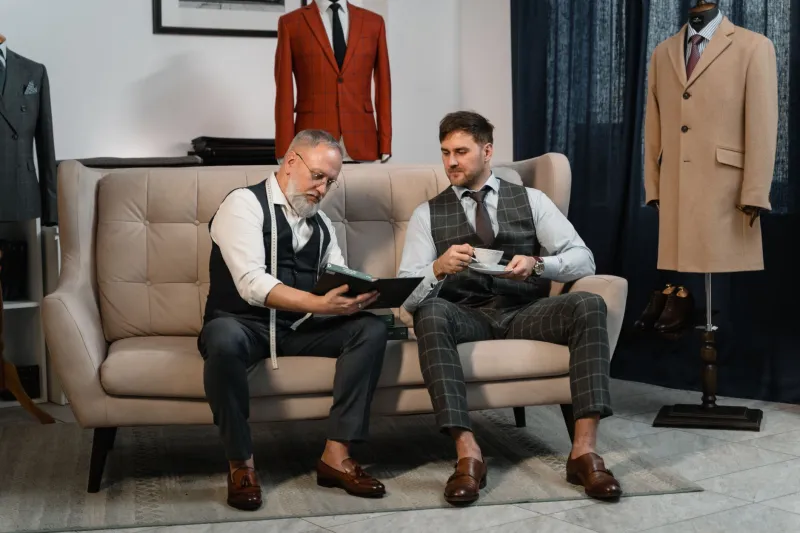
There is a wool overcoat hanging in a closet in Charleston, South Carolina, that has been worn by three different people across four decades. It was commissioned in the early 1980s by a man who wanted something he would never have to replace. His daughter wore it to her college graduation. Her son, now in his late twenties, has recently had it refitted — a minor adjustment to the shoulders, a fresh lining in a silk the color of midnight — and considers it the finest piece he owns.
No one in that family would trade it for anything newly made.
This is not a story about nostalgia, though nostalgia is certainly present. It is a story about what happens when a garment is built to a standard so uncompromising that time itself becomes irrelevant. It is a story about the quiet logic of bespoke investment — and the growing number of American clients who are commissioning pieces not merely for themselves, but for the people who will come after them.
The Architecture of Longevity
What allows a garment to survive a generation, let alone two or three? The answer, according to those who build them, begins long before the first fitting.
The fabrics selected at the finest ateliers are chosen as much for their resilience as for their beauty. A dense English worsted, a hand-loomed Scottish tweed, a silk-backed wool crepe — these materials do not simply wear well. They improve with careful use, developing a patina that synthetic blends can never replicate. The hand-stitched construction that defines true couture creates a garment that can be opened, adjusted, and rebuilt without compromising its essential integrity. There are no shortcuts fused into the chest piece, no glued interfacings that will eventually bubble and separate. Every structural decision made at the cutting table is one that a skilled tailor, years or decades later, can revisit and refine.
This is the foundation of heirloom dressing: not ornamentation, but architecture.
Commissioning With Intention
Among the most thoughtful clients working with American ateliers today, a distinct philosophy is emerging. Rather than approaching the consultation purely as an exercise in personal expression, these clients arrive with a longer horizon in mind. They ask questions that might once have seemed unusual: How will this piece age? What adjustments will it require over time? Could this garment, in twenty years, be meaningfully altered to fit someone of a different build?
One client — a grandmother in her early seventies who commissioned a structured evening jacket through an atelier consultation last year — described her thinking with characteristic precision. "I am not buying this for next season," she explained. "I am buying it because my granddaughter has my coloring and my bone structure, and I want her to have something that tells her who I was when I was at my most confident."
That kind of intentionality changes everything about the commission. The color selection becomes more considered. The silhouette is chosen not for what is fashionable this moment, but for what has always been quietly correct. The details — the weight of the buttons, the depth of the hem, the treatment of the lining — are evaluated against a longer standard.
What an Inherited Piece Carries
For those who have received a bespoke garment from someone they loved, the experience of wearing it resists easy description. It is not simply the pleasure of a well-made object, though that pleasure is real and immediate. It is something more layered — a physical connection to a person's choices, their taste, their sense of themselves at a particular moment in their life.
Margarette, a museum curator based in Philadelphia, inherited her father's bespoke dinner jacket when she was in her early thirties. Her father, a jazz musician of some renown, had commissioned it in New York in the 1970s. "The first time I put it on," she recalls, "I understood something about him I had never been able to articulate. He cared about beauty in a very specific, disciplined way. The jacket told me that. No photograph could have told me that."
She has since had the jacket altered to fit her own frame — a process she describes as a kind of dialogue between herself and the original maker, mediated by the tailor who did the work. The jacket now reflects two people. She considers that an addition, not a dilution.
The Practical Dimensions of Couture Inheritance
Passing down a garment is not without its practical considerations, and the most responsible approach acknowledges them honestly. Bespoke pieces require proper storage: breathable garment bags rather than plastic, cedar rather than mothballs, periodic airing and light steaming. A garment that has been well-maintained over decades is a fundamentally different inheritance than one that has been neglected.
Alteration is almost always necessary when a piece moves between generations, and this is not a failure of the original commission — it is proof of the garment's value. A construction that cannot be altered is a construction that cannot survive. The finest ateliers build in what experienced tailors call "the gift of cloth": deliberate seam allowances and hem depths that leave room for the future. This generosity of construction is one of the hallmarks that separates true couture from even the most expensive ready-to-wear.
Clients who commission with inheritance in mind would do well to document the piece thoroughly at the time of creation: the fabric provenance, the maker's notes, the original measurements, any particular decisions that were made and why. This record becomes part of the heirloom itself — a kind of material biography that allows the next custodian to understand what they have received.
A Different Measure of Value
In a culture that has grown accustomed to measuring value in terms of resale markets and investment returns, the heirloom garment offers a different accounting entirely. Its worth cannot be captured in any secondary market transaction. It exists in the particular weight of a sleeve on a shoulder, in the recognition of a grandmother's taste in a buttonhole worked by hand, in the private knowledge that what one is wearing was made for someone who mattered.
This is, perhaps, the most radical proposition that bespoke dressing makes to the American client: that the most valuable thing you can own is something that was made, with great care, for you — and that its value only deepens when it is eventually made, with equal care, for someone you love.
The Charleston overcoat is not finished yet. The young man who wears it now speaks, with quiet certainty, of the child he hopes to have someday. He already knows what that child will inherit.
Some garments are simply made that well.