Designed to Change: The Atelier Philosophy of Building Garments That Grow With Their Wearers
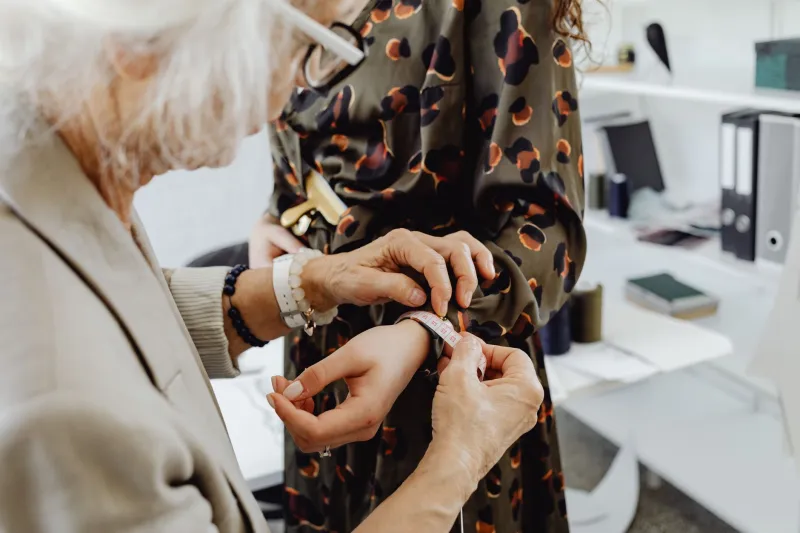
There is a particular kind of pride that a couture client feels when a garment fits precisely—when the shoulder sits without a wrinkle, when the waist follows the body's contour as though it were drawn there, when the hem breaks at the exact right point above the floor. That precision is, after all, the promise of bespoke. Yet some of the most accomplished ateliers working in America today are quietly complicating that notion of perfection. They are building garments designed, from the very first toile, to be changed.
This is not a concession to impermanence. It is, in fact, its opposite: a deeper commitment to longevity, to the idea that a truly great garment does not resist the passage of time but accommodates it with grace.
The Myth of the Static Masterpiece
Conventional thinking about couture tends to frame the finished piece as a kind of sealed artifact—something to be preserved exactly as it left the atelier. This framing borrows from the museum world, where objects are protected from alteration and displayed as they were originally made. It is a romantic notion, but it misunderstands what clothing actually does. A garment lives on a body, and bodies are not static. They shift with age, with health, with the seasons of a life. A jacket that fits perfectly at forty may tell a different story at fifty-five.
The most thoughtful designers working in the bespoke tradition have always known this. What is changing now is the degree to which that knowledge is being built into the construction process itself—not as an afterthought, but as a foundational design principle.
Engineering Flexibility From the First Cut
At the technical level, designing for evolution begins with decisions made long before the cloth is cut. Seam allowances in ready-to-wear garments are typically trimmed to a quarter inch or less, leaving no material for future adjustment. In a deliberately adaptive bespoke piece, those allowances may be left at an inch or more—folded and pressed with precision so they remain invisible to the eye while holding significant potential for expansion or refinement.
Similarly, the placement of structural elements—canvas interlinings, boning channels in evening wear, the internal architecture of a tailored coat—can be engineered to allow modification without compromising the garment's visual integrity. A skilled atelier cutter thinks not only about how the cloth will behave today, but about how its structure might be navigated years from now by another skilled hand.
Fabric selection plays an equally significant role. Certain weaves—particularly those with a looser hand or a more forgiving drape—respond more generously to alteration than tightly constructed materials. Some ateliers now discuss this dimension explicitly with clients during the initial consultation, framing fabric choice not only in terms of current aesthetics but future adaptability.
The Philosophical Shift: From Object to Relationship
Beyond the technical, this approach reflects a meaningful shift in how some designers understand the purpose of their work. A garment conceived as a static object is finished when it leaves the workroom. A garment conceived as a relationship continues to unfold.
This perspective draws on traditions that predate modern fashion entirely. Tailors in earlier centuries routinely expected that a well-made coat would be let out, taken in, re-lined, and re-trimmed multiple times over its working life. The idea that a garment might serve one body in one configuration for its entire existence is, historically speaking, the anomaly. The adaptive approach is, in a sense, a return to an older and more honest understanding of craft.
For American clients accustomed to a culture of disposability—where the impulse to replace rather than repair has become almost reflexive—this philosophy can feel quietly radical. Ateliers that articulate it clearly often find that it resonates deeply with clients who have grown weary of that cycle, who are drawn to bespoke precisely because they are seeking objects that reward commitment rather than demanding constant renewal.
Customization as Collaboration Across Time
One of the more compelling dimensions of adaptive bespoke design is the way it extends the collaborative relationship between client and atelier across years rather than weeks. When a garment is designed to evolve, the fitting room conversation does not end at delivery. It continues—perhaps two years later, when a client returns to have a jacket re-shaped after a significant change in their body; perhaps five years on, when a gown's neckline is reconstructed to reflect a shift in personal style.
Some ateliers are formalizing this relationship by maintaining detailed records not only of measurements but of the construction decisions made specifically to enable future modification. Notes on seam allowances, on the type of canvas used, on the way a lining was attached—all of this becomes a kind of technical archive that allows any skilled craftsperson to engage with the piece intelligently, even decades after it was originally made.
This archival thinking transforms the atelier from a place where garments are produced into something more like a stewardship practice—a relationship between maker and client that is explicitly oriented toward the long term.
What Clients Bring to the Evolution
The adaptive garment is not only shaped by the body's changes. It is shaped by the evolving aesthetic sensibility of the person who wears it. A client who commissioned a formal evening coat at thirty-five may find, a decade later, that their relationship to formality itself has shifted—that they want the same coat to carry a different kind of authority, or to speak in a quieter register.
Ateliers that build for evolution understand that this is not a failure of the original design. It is the design working exactly as intended. The garment was made to remain in conversation with its wearer, not to hold them fixed in the moment of its creation.
This is, ultimately, the most generous thing a designer can offer: not a perfect object, but a responsive one. Not a conclusion, but a continuing dialogue—measured in fittings and alterations and the slow accumulation of a life well dressed.
The Garment as Long-Term Investment
For clients weighing the considerable investment that couture represents, the adaptive approach offers a compelling reframing of value. A garment built for a single, unchanging configuration must be replaced when that configuration shifts. A garment built for evolution can accompany its wearer through multiple chapters of a life, accruing meaning and history with each thoughtful modification.
The economics are straightforward, but the emotional logic runs deeper. When a piece of clothing has been altered twice, re-lined once, and worn across fifteen years of significant occasions, it carries a kind of weight that no new acquisition can replicate. It has become, in the truest sense, part of a personal history.
That is the promise the finest ateliers are now making explicit: not a garment that is finished, but one that is perpetually, beautifully becoming.