Dressed by Instinct: What the Maker's Own Wardrobe Reveals
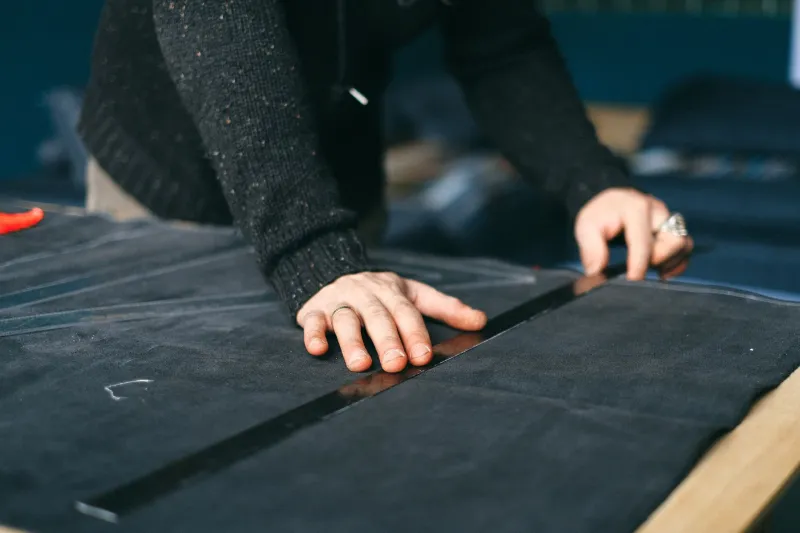
There is a quiet irony at the center of the atelier world. The people who devote their professional lives to constructing garments of exceptional precision—who spend hours debating the fall of a lapel or the precise weight of an interlining—must, at the end of each working day, decide what to wear themselves. It is a decision most of us make reflexively. For the master craftsperson, it is rarely so simple.
Their wardrobes are, in a sense, the most honest form of criticism they will ever offer. Free from the obligations of a client brief or a collection concept, the maker's personal dress reveals what they actually value once the professional calculus is set aside. What emerges, when you look closely, is neither uniform nor predictable—but it is almost always instructive.
The Case for the Personal Uniform
Among experienced ateliers and senior tailors, one approach recurs with striking frequency: the deliberate adoption of a personal uniform. A single silhouette, repeated across interchangeable garments. A narrow palette—navy, charcoal, ivory, stone—executed in fabrics chosen with the same rigor applied to client commissions.
This is not, as it might appear from the outside, an absence of sartorial opinion. It is, rather, the fullest expression of one. The craftsperson who has spent years navigating the infinite variables of bespoke work—fabric weight, grain line, seam allowance, hand—arrives, eventually, at a kind of clarity. They know precisely what flatters their frame. They understand which cloth performs best across a long day on their feet. They have no interest in trend, because they have seen, firsthand, how quickly trend unravels.
The personal uniform is, in this light, a form of discipline. It removes the noise. It allows the maker to move through the world without the distraction of clothing that demands attention, reserving that attention entirely for the work at hand.
The Maker as Experimentalist
Not every artisan arrives at restraint. For some—particularly those working at the intersection of couture and conceptual design—the personal wardrobe functions as a laboratory. These are the craftspeople who wear their own prototypes, who test drape and construction on themselves before presenting anything to a client, who treat their bodies as the first fitting dummy in every collection.
This approach carries its own logic. The maker who wears what they make, who lives inside the garment through ordinary days rather than extraordinary occasions, develops a sensibility that no amount of studio observation can replicate. They understand fatigue—where a seam begins to pull after six hours, where a lining grows warm in an overheated room, where a collar sits beautifully at nine in the morning and begins to shift by afternoon.
For these artisans, dressing is inseparable from learning. Each garment worn is a lesson absorbed into the body, informing the next commission in ways that are difficult to articulate but immediately legible in the finished work.
What Fabric Choices Betray
Perhaps nowhere is the maker's philosophy more legible than in their choice of cloth. The senior tailor who insists on a mid-weight wool flannel, season after season, is communicating something precise: a belief in the supremacy of natural fiber, in the beauty of a fabric that softens and molds over time, in the idea that a garment should improve with wear rather than merely survive it.
The couture designer who reaches, in her private hours, for an unlined linen jacket—cut simply, worn loosely—is making an equally clear statement. Formality, for her, is a professional mode. Off the clock, she wants the fabric to breathe, to move, to forget that it is being worn at all.
These choices, accumulated over a career, form something close to a sartorial autobiography. The maker's wardrobe is the record of everything they have learned, distilled into the most personal possible expression.
The Paradox of the Expert Eye
There is a particular challenge that confronts anyone who possesses deep expertise in a craft: the inability to stop seeing. The master tailor who enters a room does not simply observe the people in it. They read the break of every trouser, assess the roll of every lapel, register the precise moment at which a shoulder seam has been set too far forward. This is not vanity. It is professional reflex, as automatic and involuntary as a musician hearing a flat note.
For their own wardrobes, this creates an unusual pressure. The craftsperson cannot dress carelessly, because carelessness is immediately visible to them in a way it simply is not to others. A poorly pressed sleeve, a button sewn with the wrong tension, a collar that has begun to cup—these are not minor imperfections. They are, to the trained eye, loud failures.
And yet many of the most accomplished makers dress with a kind of deliberate ease that belies this awareness. They have made their peace with the gap between the ideal and the lived. They understand that a garment worn daily will eventually bear the marks of that dailiness, and they have come to regard those marks not as failures but as evidence of a life well dressed.
Craft as Conviction
What unites the minimalist, the experimentalist, and the quiet perfectionist is a shared conviction: that clothing matters. Not in the superficial sense of status or display, but in the deeper sense of intention. The maker who has devoted a career to the construction of garments for others has, through that work, arrived at a set of beliefs about what clothing can and should do. Their own wardrobe is where those beliefs are tested without the buffer of a client relationship or a collection narrative.
At SGBG Atelier, this philosophy is not incidental to the work—it is foundational to it. The artisans who shape each commission bring to that work the full weight of their own sartorial convictions. They dress as they believe. And in doing so, they remind us that the most credible advice about clothing will always come from those who have thought longest and hardest about what it means to be dressed well.
The maker's wardrobe is, in the end, the most honest garment they will ever produce. It is made for no audience but themselves—and that, perhaps, is precisely what makes it worth studying.