Dressed in Another's Story: The Intimate Art of Inheriting Couture
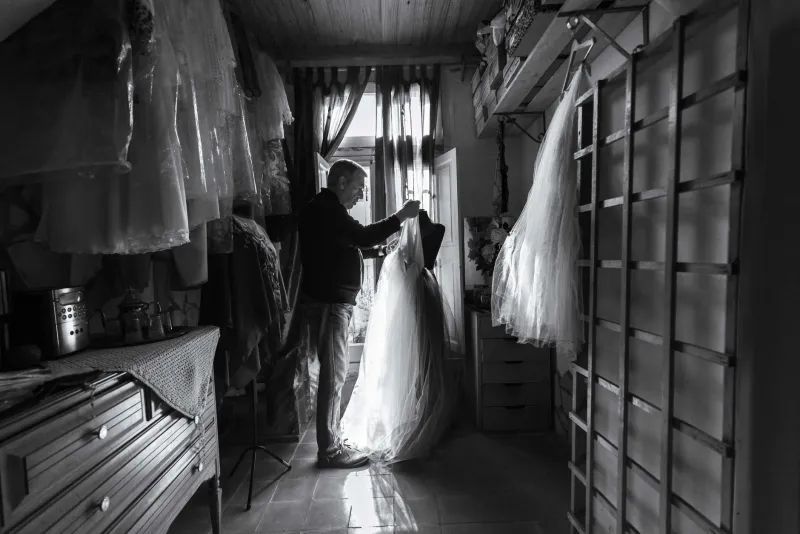
Every bespoke garment begins as a portrait. The measurements, the posture adjustments, the accommodations made for a particular shoulder height or a slight asymmetry in the torso—these are not merely technical specifications. They are a record of a specific human body, at a specific moment in time, rendered in cloth and thread.
When that garment passes to someone else, the portrait does not disappear. It simply acquires a new wearer.
The Weight of a Well-Made Thing
Inheriting couture is not like inheriting a piece of jewelry or a work of art. A painting can be hung on any wall. A ring can be resized with relative simplicity. But a bespoke jacket, built around the precise geometry of one person's frame, carries within its structure an argument about proportion, balance, and fit that was resolved for a body that may bear little resemblance to your own.
This is the first and most immediate challenge for anyone who steps into an inherited or borrowed piece: the garment was not made for you, and it knows it.
The experience can range from the pleasantly approximate to the genuinely disorienting. A mother's evening coat, cut for a narrower shoulder, may require only minor adjustment to feel at home on her daughter. A grandfather's dinner jacket, tailored for a fuller chest in an era of different silhouettes, may present a far more complex negotiation. The cloth is extraordinary. The construction is irreproachable. And yet the garment insists, quietly but firmly, on the body it was made for.
The Question of Alteration
For many inheritors of bespoke pieces, the question of whether to alter a garment is among the most fraught they will face. On one side lies wearability—the practical reality that a garment worn is a garment honored. On the other lies something harder to name: a reluctance to disturb the record that the original maker left behind.
Experienced couture ateliers who have handled inherited commissions describe this tension with considerable nuance. The consensus, broadly, is that alteration is not inherently disrespectful—but that it demands a different kind of care than a new commission.
Where a new garment invites the maker's full creative engagement, an inherited piece asks for something more like archaeology. The goal is not to remake but to adapt—to find the minimum intervention that allows the garment to function on a new body without erasing the decisions that made it extraordinary in the first place.
The interior canvas of a well-made jacket, for instance, is a document of the original tailor's thinking. The hand-stitched pad stitching that gives the chest its shape, the careful distribution of ease across the back—these are not incidental. A skilled alteration specialist approaches them with corresponding respect, working within the original structure rather than against it.
What Borrowed Confidence Actually Means
Not all inherited couture arrives through formal bequest. Some of the most interesting cases involve garments borrowed between contemporaries—a friend's custom dress worn to a formal occasion, a colleague's bespoke blazer pressed into service for an unexpected event.
This borrowing carries its own psychology. There is a particular quality to wearing something that was made with absolute conviction for someone else. It does not fit the way your own clothes fit. The armhole sits at a slightly different angle. The lining carries the faint suggestion of another person's presence. And yet there is something unexpectedly freeing about inhabiting a garment that carries no anxiety about your own taste—because it was never about your taste to begin with.
Several stylists who work with American clients at the higher end of the market have noted this phenomenon with interest. Clients who are ordinarily quite deliberate about their appearance sometimes discover, in wearing a borrowed bespoke piece, a kind of liberation. The garment makes decisions for them. Its authority is established. They need only wear it.
This is not, of course, a sustainable philosophy. But it illuminates something genuine about the nature of couture confidence: it can be inherited, at least temporarily, along with the garment itself.
Respect, Identity, and the Garment's Own Claim
The most sophisticated inheritors of bespoke pieces tend to develop a particular relationship with the garments in their care—one that acknowledges the original commission without being enslaved to it.
This means understanding the garment's history without feeling obligated to recreate it. A 1960s Balenciaga-influenced suit that once belonged to a formidable aunt need not be worn as she wore it, to the occasions she wore it, in the spirit she brought to it. What it asks of its new wearer is something simpler: to be treated as the serious object it is, and to be given occasions worthy of its construction.
It also means recognizing that some alterations are acts of respect rather than erasure. Replacing a worn lining preserves the garment. Adjusting a hem for a new proportion allows it to be worn rather than displayed. The question is not whether to intervene, but how—and with what degree of attention to what was there before.
Ateliers who specialize in this kind of restoration work often speak of the process as a conversation with an absent maker. They are reading decisions made by someone else, understanding the logic behind them, and then deciding what to honor and what to gently revise.
The Living Garment
There is a view of couture that treats finished garments as fixed objects—completed at the final fitting and thereafter unchanging. This view has a certain romance to it, but it does not reflect the reality of how extraordinary clothing actually lives.
The most enduring bespoke pieces are those that have been worn, adapted, repaired, and passed forward. They accumulate history not as damage but as depth. The faint impression of a previous owner's shoulder, visible to the trained eye in the drape of a jacket, is not a flaw. It is a record.
To wear another person's couture is to add your own chapter to that record. The garment began as their portrait. In your hands, it becomes something more layered—a document of more than one life, more than one body, more than one moment of choosing to dress with intention.
That is not a burden. It is, for those who approach it thoughtfully, one of the quieter privileges that extraordinary clothing can offer.