Ask Before You Order: The Five Inquiries That Reveal a True Bespoke House
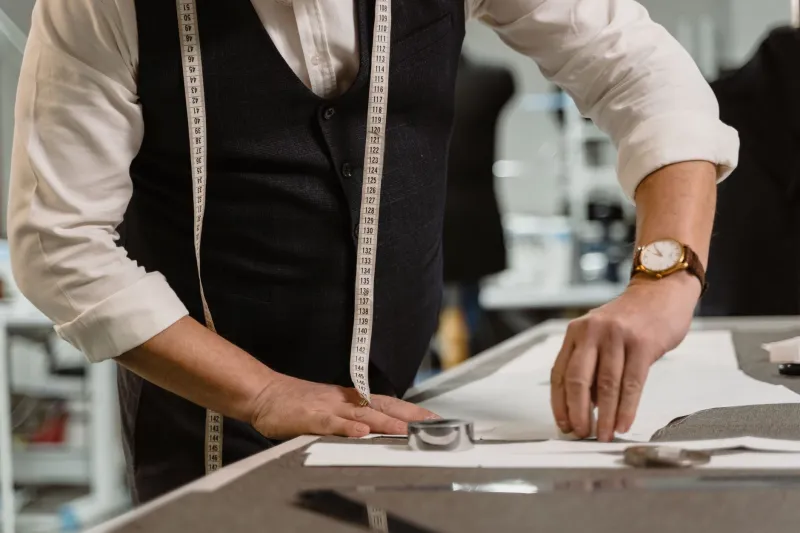
Photo: tailor's hands measuring fabric pattern drafting table atelier, via c8.alamy.com
Few words in fashion have been devalued as thoroughly as bespoke. It appears on websites for operations that never cut a pattern, on garments assembled from stock blocks with a client's measurements entered into software, on services that would be accurately described as made-to-measure — a legitimate craft, but a different one.
The distinction matters financially and philosophically. True bespoke means a pattern drafted uniquely for you, cut by hand, fitted in stages, and constructed by people whose names you can learn. Made-to-measure means your measurements applied to an existing base pattern. Both can produce fine clothing. Only one produces a garment that exists nowhere else in the world.
If you are preparing to commission, do not rely on vocabulary. Rely on questions. The following five, asked politely and without apology, will reveal more in ten minutes than any website can.
1. "Will you draft a pattern for me, or adjust an existing block?"
This is the foundational question, and the only acceptable answer is the former. A house that drafts from scratch will describe the process readily — how many measurements, how the draft is refined across fittings, where the pattern lives afterward. Hesitation, or a pivot to phrases like "fully customized" and "personalized to your measurements," suggests a base block with alterations.
Listen, too, for whether your pattern is retained. Established houses keep client patterns on file for decades, which is what allows a second commission years later to fit as well as the first.
2. "How many fittings are included, and what happens between them?"
A bespoke garment is not fitted once. Expect a minimum of two to three fittings — often a skeletal or basted fitting with the garment loosely stitched, then further sessions as construction proceeds. Ask what happens if the fit is wrong at the final stage: a confident house will alter without complaint and without invoice, because the fittings exist precisely to prevent that outcome. A house that treats additional fittings as billable contingencies is telling you how it expects its process to go.
3. "Who makes the garment, and where?"
You are entitled to know whether the people cutting and sewing your clothing are employees of the house or an outsourced factory, and whether they work in the building you are standing in. There is nothing inherently wrong with offshore production — but there is something wrong with offshore production wearing the language of the atelier. Ask for names. A true workshop talks about its makers the way a restaurant talks about its kitchen.
4. "Can you walk me through the construction?"
This question is less about the answer than about the answerer's fluency. A house with genuine craft will explain — unprompted and with enthusiasm — whether the jacket has a full or half canvas, whether the lapels are padded by hand, how the trousers are finished at the seat and inseam. Vague responses about "quality construction" and "premium materials" are not disqualifying on their own, but combined with any other evasive answer, they complete a pattern.
If you want a concrete test: ask whether the collar of a jacket is attached by hand. It is a small, verifiable detail, and anyone who actually makes garments this way will enjoy being asked.
5. "What is included in the price — and what is not?"
Pricing opacity is the most common red flag, and the most forgivable, because many clients never ask. But a house confident in its value will quote a figure that includes fabric within a stated range, all fittings, and all alterations — and will tell you plainly where additional costs arise: certain cloths, unusual linings, expedited timelines. Beware quotes that balloon after the first fitting, and beware the inverse as well: prices too low for handwork are a promise that handwork is not happening.
The Question Behind the Questions
Notice what all five inquiries share: they ask the house to describe its own process in specifics. Genuine ateliers welcome this. Their craft is their differentiation, and they can talk about it all day. It is the operations wearing the label that deflect — toward brand heritage, toward fabric brands, toward the word luxury deployed as a substitute for method.
One final observation. The act of asking well changes the relationship before a single measurement is taken. A house that respects you will respect the questions; a house that bristles has answered a sixth question you didn't need to ask. In bespoke, as in most things worth commissioning, the process is the product. Interrogate it accordingly.