The Polite Fictions of the Fitting Room: What Clients Don't Tell Their Tailors
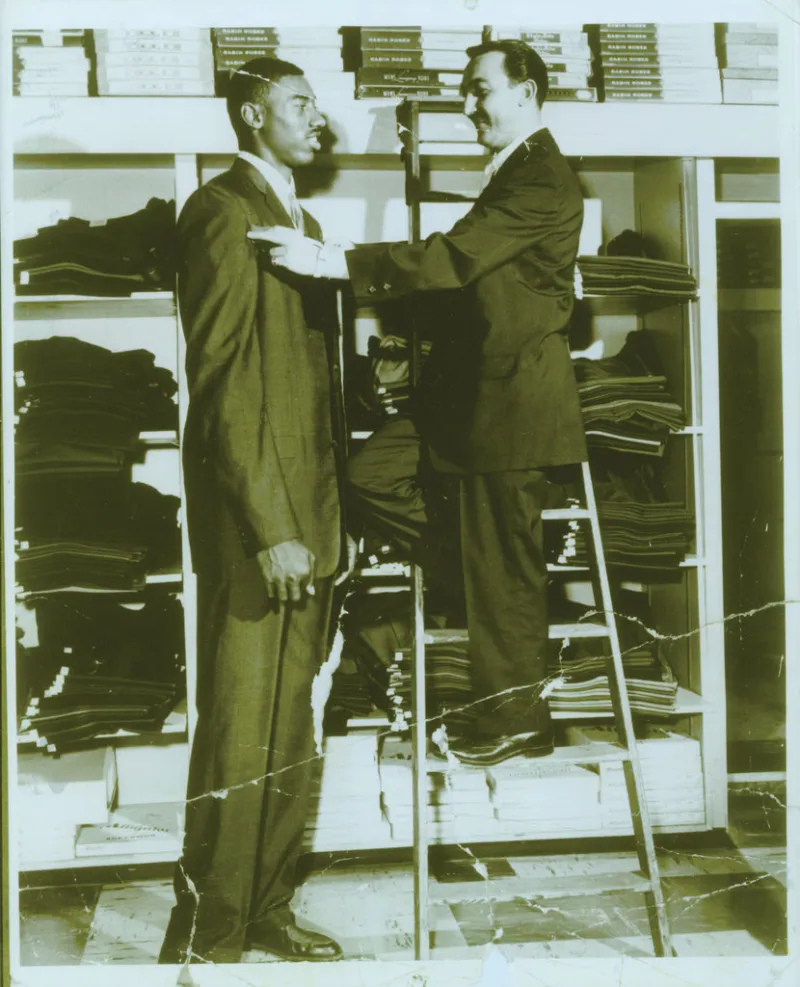
Photo: Mbrownboyds, CC BY-SA 4.0, via Wikimedia Commons
There is a ritual played out in fitting rooms across the country, from Savile Row–trained studios in Chicago to one-tailor operations in Portland, that rarely appears in any brand's marketing: the client, standing on the pedestal in a basted jacket, being asked a direct question — and answering with something adjacent to the truth.
Do you carry a bag on your right shoulder? "Occasionally."
Do you drive long distances? "Not really."
Is the sleeve comfortable? "It's perfect."
Each answer is courteous. Each is also, in some measurable percentage of cases, untrue. And in bespoke, where a garment is drafted around the specifics of one body and one life, a small untruth does not dissipate the way it might in retail. It gets sewn in.
The Anatomy of the Fitting-Room Lie
The lies clients tell are rarely grand deceptions. They are acts of social management, and they cluster into recognizable types.
There is the aspirational lie — the client who claims they will wear the garment weekly when they know, privately, it is destined for two weddings a year. There is the flattery-avoidance lie: the client who says the waistband is fine because admitting discomfort feels like criticizing the maker's competence. There is the lifestyle minimization, in which a client undersells how much they sit, drive, travel, or sweat — the unglamorous mechanics of an actual life. And there is the politeness lie, the reflexive "it's lovely" offered to a craftsman standing three feet away with chalk in hand.
A veteran fitter in New York described it bluntly: "Nobody lies about their chest measurement. They lie about their Tuesday."
That Tuesday is precisely what bespoke is for. A garment drafted for an idealized version of the wearer — the one who stands straight, doesn't carry a laptop, and never reaches overhead — will look magnificent on the pedestal and fail quietly in the world. The collar that gaps only when a seatbelt crosses it. The cuff that strains at a keyboard. The pocket placement that assumes hands that never carry a phone.
What the Untruth Costs
The financial cost is obvious: a garment that requires rework, or worse, one that never gets worn and becomes an expensive monument to a moment of tact. But the subtler cost is to the craft itself. A tailor can only fit the person presented to them. When a client curates their own behavior during a fitting, the maker is denied the raw material of truth from which all good patterning flows.
There is also a cost paid by the relationship. Bespoke is built on a series of honest exchanges over months. A client who manages the first fitting will be managed by the second: the maker, sensing evasion, stops asking. The conversation narrows. The garment becomes technically correct and personally generic — which is to say, bespoke in name only.
How Ateliers Engineer Honesty
The better houses do not simply hope for candor. They design for it.
Some ask clients to bring the objects of their daily life to the fitting — the actual bag, the actual shoes, the phone in its usual pocket. Behavior is harder to misrepresent when it is standing in the room.
Others replace yes-or-no questions with comparative ones. "Is the sleeve more comfortable than the jacket you're wearing?" is difficult to answer diplomatically; the answer contains information either way. Several ateliers deliberately schedule second fittings for early morning or late afternoon, when a body has settled into its real posture and the client has stopped performing.
The most effective tactic, veteran makers report, is also the simplest: the fitter lies first. Admitting that a previous client stretched the truth — "everyone tells me the shoulder is fine, and half the time it isn't" — grants permission. Once the client understands that discomfort is data rather than insult, the fitting room changes character entirely.
Candor as the True Luxury
There is an irony worth naming. Clients who can afford bespoke often possess the finest manners, and manners, in the fitting room, are quietly destructive. The restraint that serves a person at dinner works against them on the pedestal.
The most successful bespoke relationships we have observed share one trait: the client decided, early, that the tailor was not a guest to be hosted but a collaborator to be briefed. They described the sweat, the slouch, the long flights, the twelve-pound bag. They said "it pulls" without apology.
The result is not merely a better-fitting garment. It is a garment that documents a real life rather than a presentable one — which is, in the end, the entire proposition. Fabric can be bought anywhere. A garment built on the truth of how you actually live cannot.
Candor, it turns out, is the one material the atelier cannot supply. It must come from the client. And unlike cloth, it costs nothing — only a small, worthwhile surrender of composure.