Cotton Before Cloth: Reading the Toile at the Bespoke Atelier
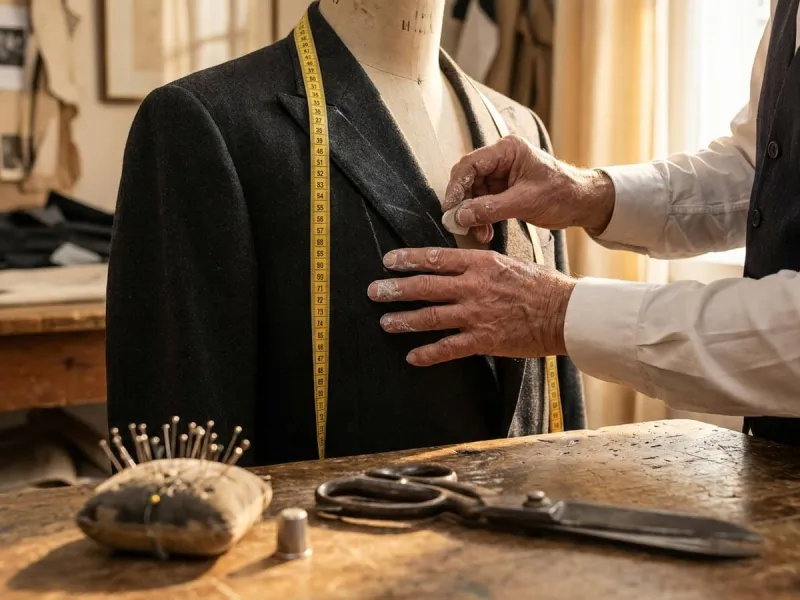
Photo: tailor fitting cotton toile muslin jacket in atelier, via manofmany.com
The toile is the bespoke atelier's most honest document. Cut in unbleached cotton or a modest muslin, it is a garment without the seduction of cashmere, vicuña, or fresco wool. It has no finish to distract the eye and no label to flatter the wearer. What it has is architecture—and in that architecture, a client's posture, movement, and unspoken preferences are laid bare. For the discerning client, the toile fitting is not an inconvenience between measurement and delivery. It is the moment when a commission becomes legible.
The Garment in Draft
A toile is sometimes described as a rehearsal, but that word understates its role. A rehearsal implies that the real performance is elsewhere. In bespoke tailoring, the toile is the performance of structure. It shows where a shoulder seam wishes to sit, whether a lapel rolls cleanly, how a waist suppression behaves when the wearer reaches across a table, and whether a jacket's balance survives the simple act of sitting down. The final cloth may be more beautiful, but the toile is more informative.
This is why experienced makers treat the toile with the same seriousness as the finished garment. Pins are placed with intention. Chalk marks are made in a private shorthand. The cutter may step back, tilt his head, and ask the client to walk a few paces—not to evaluate the walk, but to see how the garment negotiates it. In that small exercise, the difference between a garment that fits a stationary body and one that fits a living person becomes clear.
What the Cotton Cannot Hide
Luxury cloth can be forgiving. Its weight, drape, and surface can mask a dozen small compromises. Cotton is less generous. It exposes a shoulder that has been cut too square, a back that lacks sufficient ease, or a sleeve that has been set without regard for the client's habitual gesture. For the maker, this is not an embarrassment; it is the point. The toile is the stage at which correction is inexpensive and precise. Once the final cloth is cut, every adjustment becomes a negotiation with irreplaceable material.
For the client, the toile fitting offers a rare form of clarity. It is difficult to judge the line of a jacket when one is mesmerized by a beautiful tweed. It is easier to judge that line in plain cotton. The toile asks the client to look at proportion rather than color, at balance rather than finish. This is not an aesthetic deprivation. It is an education in what the garment actually is.
Movement Is the True Measurement
A measurement tape records the body at rest. Bespoke tailoring must account for the body in motion. The toile fitting is where this distinction is explored. The client is asked to raise an arm, clasp the hands, turn the shoulders, and sit. Each action reveals a different requirement. A sleeve that looks correct in a static pose may bind when the arm is extended. A back that appears clean while standing may pull when the client leans forward.
The atelier is not looking for a garment that accommodates every conceivable movement. That would produce a shapeless result. It is looking for a garment that accommodates the movements the client actually makes—the way he reaches for a file, carries a child, drives, or gestures during conversation. These habits are rarely stated in the consultation. They emerge in the fitting room, often without the client's awareness. The toile catches them.
The Client's Unspoken Brief
Clients often arrive with a verbal brief: a navy blazer, a soft shoulder, a suit for a wedding in Maine. But the unspoken brief is more revealing. A client may say he wants a relaxed garment, then stand with military rigidity. He may ask for a traditional cut, then respond instinctively to a closer silhouette. The toile fitting permits the maker to test these contradictions in cloth rather than in conversation.
This is also where the client's tolerance for precision becomes apparent. Some clients want a garment that follows the body closely; others want room for ambiguity. The toile allows both maker and client to see the consequence of a choice before it becomes permanent. It is a form of informed consent, conducted in pins and chalk.
The False Economy of the Shortcut
There are ateliers that offer to skip the toile, particularly for clients who are traveling or impatient. The rationale is efficient: measurements are taken, a pattern is drafted, and the final garment is fitted once. This can work when the pattern is familiar and the garment is simple. It is rarely wise for a first commission, a complex garment, or a client with pronounced posture.
The cost of skipping the toile is not merely the risk of a poor fit. It is the loss of a diagnostic stage. Corrections that could have been made in cotton must instead be made in the final cloth, often with less satisfactory results. The client may receive a garment that fits adequately, but adequacy is not the standard of true bespoke. The atelier may absorb the cost of remaking a sleeve or recutting a back, but the lost time and material are real. The false economy is shared.
A Shared Language in Muslin
The toile also serves a relational purpose. It gives the client and the maker a shared object to discuss. Instead of speaking abstractly about drape or line, they can point to a specific fold, a particular seam, a pinned shoulder. The conversation becomes concrete. The client learns to read the garment; the maker learns to read the client.
In a high-end atelier, this is not a bureaucratic step. It is the heart of the craft's collaborative nature. The final garment may be made of the finest cloth, but its intelligence is established in humble cotton. The toile's tale is one of honesty, correction, and mutual understanding. For the client who wishes to commission with confidence, it is the most revealing moment in bespoke—and the one least wise to omit.