The Danger of Perfect Taste: When a Client's Restraint Becomes the Room's Greatest Obstacle
A client who arrives at the fitting room with impeccable instincts and a firm commitment to understatement is, in many respects, a maker's ideal. She knows what she wants. She communicates clearly. She does not chase trends or second-guess her own sensibility. In a field where indecision is among the most common complications a craftsperson navigates, her clarity is genuinely refreshing.
And yet seasoned couturiers will tell you, in quieter moments, that the most difficult commissions are not born from excess or confusion. They are born from a certain kind of refined certainty that forecloses possibility before a single seam has been sewn.
The Anatomy of Tasteful Paralysis
Consider a scenario that will be familiar to any maker who has spent significant time in a bespoke fitting room. A client arrives with a coherent, well-considered vision. She wants navy. She wants a clean lapel. She wants nothing that will draw attention to itself. She has arrived, in other words, at a set of conclusions—and she has arrived there not through carelessness, but through years of careful self-editing.
The maker examines her posture, her coloring, the particular way she holds her shoulders, the slight asymmetry in her stance that a skilled eye reads as an opportunity rather than a problem. He sees, perhaps, that a slightly longer break in the trouser would transform the proportion of the silhouette. He recognizes that a fabric with a barely perceptible texture would add depth without adding noise. He understands that the version of navy she has requested will be handsome, and that the version he is imagining would be something considerably more.
And then comes the moment of choice: does he say so?
The Maker's Dilemma
The bespoke relationship is, at its core, a collaboration. The client's vision is not merely a starting point to be refined away—it is the commission's purpose. A maker who consistently overrides a client's stated preferences in favor of his own aesthetic judgment has confused service with self-expression. This is a real failure, and it is worth naming clearly.
But the inverse failure is equally real, and considerably less discussed. A maker who remains silent when silence costs the client something—who does not offer the perspective that his expertise uniquely equips him to provide—has also failed in his responsibility. He has simply failed more quietly, in a way that feels like respect but functions as a kind of professional abdication.
The difficulty lies in distinguishing between these two situations. When does a client's restraint reflect genuine self-knowledge, and when does it reflect a habit of self-limitation that the atelier relationship is uniquely positioned to interrupt?
Reading the Room: What Silence Actually Communicates
Experienced makers develop, over time, a sensitivity to this distinction. There are clients whose minimalism is expansive—who have arrived at their aesthetic through genuine exploration and whose economy of expression is, in fact, a form of confidence. With these clients, the maker's role is largely to execute, to refine, and to honor what they have already understood about themselves.
There are other clients whose restraint is more anxious in character. They retreat to the familiar not because it represents their fullest self, but because it represents safety. They have learned, perhaps through social conditioning or professional caution, that drawing attention to oneself is a risk—and they have allowed that lesson to narrow the range of what they permit themselves to want.
For this second type of client, the atelier consultation is an opportunity that extends well beyond the garment itself. It is a space in which someone with no stake in the outcome—no social relationship to protect, no judgment to render—can offer a perspective that the client's own circle is unlikely to provide. That opportunity, when a maker chooses not to take it, is simply lost.
The Art of the Well-Timed Suggestion
None of this argues for a maker who lectures, pressures, or substitutes his own preferences for the client's. The manner in which a perspective is offered matters as much as the perspective itself. There is a considerable difference between telling a client what she should want and inviting her to consider something she may not have imagined.
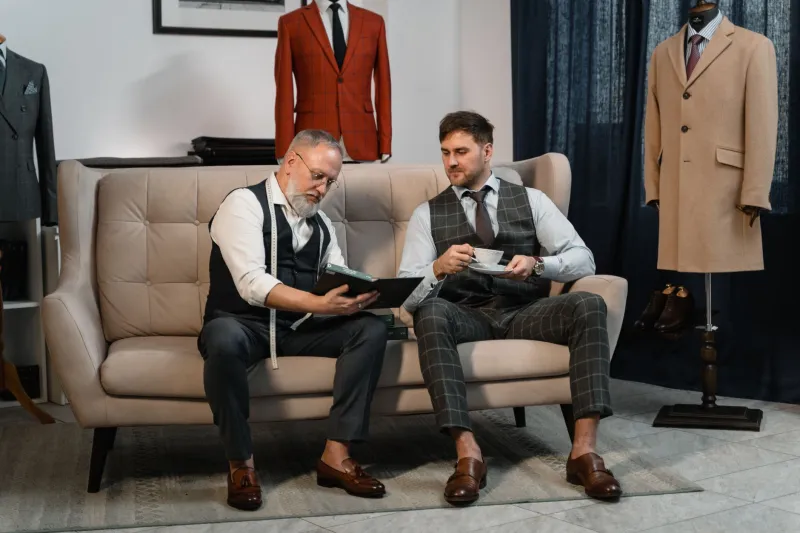
The most skilled practitioners in this field have developed a vocabulary for exactly this kind of invitation. They frame alternatives as questions rather than corrections. They show rather than explain, draping a different fabric against the body or holding a revised sketch beside the original so that the comparison can speak for itself. They create conditions in which the client can encounter a new possibility without feeling that her own judgment has been challenged.
And when the client, having genuinely considered the alternative, returns to her original instinct—they honor that without reservation.
When Staying Silent Is the Greater Mistake
There is a version of professional courtesy that is, in practice, a form of cowardice. It looks like deference. It presents itself as respect for the client's autonomy. But when a maker withholds an observation that could genuinely serve the person in front of him—because the conversation might be awkward, because he fears the client's displeasure, because it is simply easier to proceed without complication—he has prioritized his own comfort over his client's interest.
The clients who return to an atelier year after year, who build the kind of long-term relationships that define the bespoke experience at its best, are almost never those who were simply given what they asked for. They are the ones who were given something more: a maker willing to see them fully, to speak honestly, and to believe that their style potential was worth the slight discomfort of a candid conversation.
Good taste, in the end, is not a destination. It is a practice. And the atelier, at its finest, is the place where that practice is gently, persistently, and respectfully deepened.