The Virtue of the Polite No: Why Principled Ateliers Decline Commissions

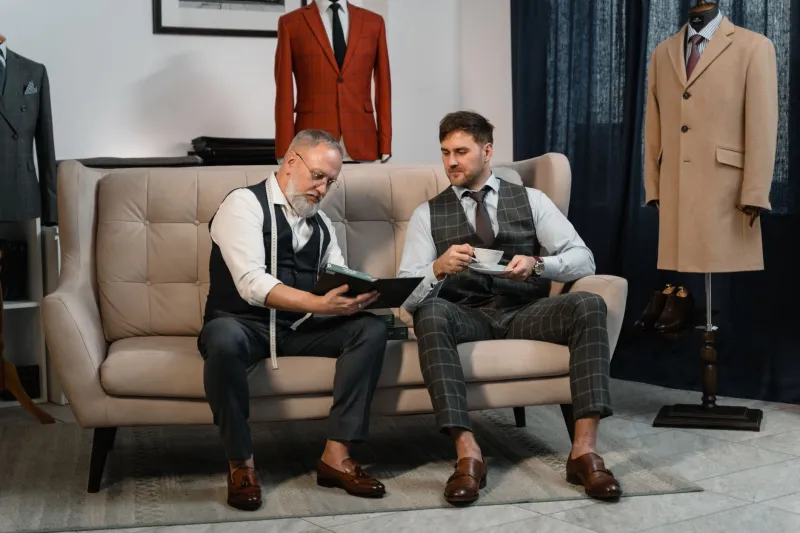
Photo: Acabashi, CC BY-SA 4.0, via Wikimedia Commons
The literature of bespoke tailoring is largely a literature of yes. We celebrate the commission accepted, the cloth chosen, the coat delivered. The refusals are rarely discussed, partly because they are awkward and partly because they are commercially inconvenient. They are, nonetheless, among the most useful things an atelier can say.
The Temptation to Say Yes
A bespoke house that declines work turns away revenue in a trade where revenue arrives slowly. The temptation to accept every commission is therefore considerable, and it is strongest in exactly the cases where it should be resisted: the wedding in six weeks, the client who wants a silhouette the house has never cut, the customer who admires a rival's coat and asks for a copy.
Three Honest Refusals
The first concerns time. A house that knows its method — the fittings, the rest periods, the handwork that cannot be compressed — also knows how long it takes. Accepting a timeline that the process cannot support produces either a rushed garment or a missed date. A refusal in this case is a statement of fact.
The second concerns fit and expectation. Some bodies and some desires are simply outside a house's idiom. A tailor who has spent thirty years cutting a soft, natural shoulder may be the wrong person to execute a sharply structured military line, however capable he is in the abstract. The honest answer is a referral, not an experiment at the client's expense.
The third concerns aesthetics and ethics. A request to replicate another house's design, or to produce a garment under conditions that would compromise the work, deserves a clear refusal. So does a commission that the atelier believes will disappoint — the cloth that will not behave, the detail that will not survive the first cleaning.
The Refusal That Is Not Integrity
Integrity is not the only reason a house says no, and clients should be able to tell the difference. A refusal that arrives with no explanation, no alternative, and no referral may be arrogance, not principle. A house that refuses everything difficult may simply be understaffed or risk-averse. The test is the quality of the refusal: a principled atelier explains the obstacle, offers a path — a later date, a different cloth, a trusted colleague — and remains courteous when the client takes that path elsewhere.
How a No Is Delivered
The setting matters. A considered house raises the difficulty at the consultation, before a deposit is taken, and does so in person or by telephone rather than in a line of email. It names the obstacle plainly and does not dress up a commercial judgment as a matter of principle. Clients should listen for that clarity. Vagueness in a refusal is often the sound of a house that has not decided whether it is declining the work or merely negotiating the price.
How to Read a No
Do not treat a refusal as a judgment of your taste or your figure. Treat it as information about the house's range. Ask what would have to change for the commission to be accepted: a longer timeline, a different cloth, a simpler design. The answer will tell you whether the refusal was about you or about the work.
If the answer is unsatisfactory, accept it and move on. A house that cannot articulate its reasons is unlikely to articulate its standards.
What the No Protects
A principled refusal protects both parties. It protects the client from a garment that was never going to be right, and it protects the atelier's standard, which is the only asset it truly owns. In an industry that increasingly rewards availability, the willingness to decline is a form of quality control.
The Client Who Is Worth Refusing
There is an odd compliment buried in a refusal. A house that will not take your money on bad terms is a house that intends to be there when the terms are good. The commission that got away is often the one that would have damaged the relationship — and the garment — beyond repair.
Consider, then, the polite no as part of the service. It is the least visible form of care, and sometimes the most valuable.