Who Else Touches Your Coat: Inside the Atelier's Circle of Makers

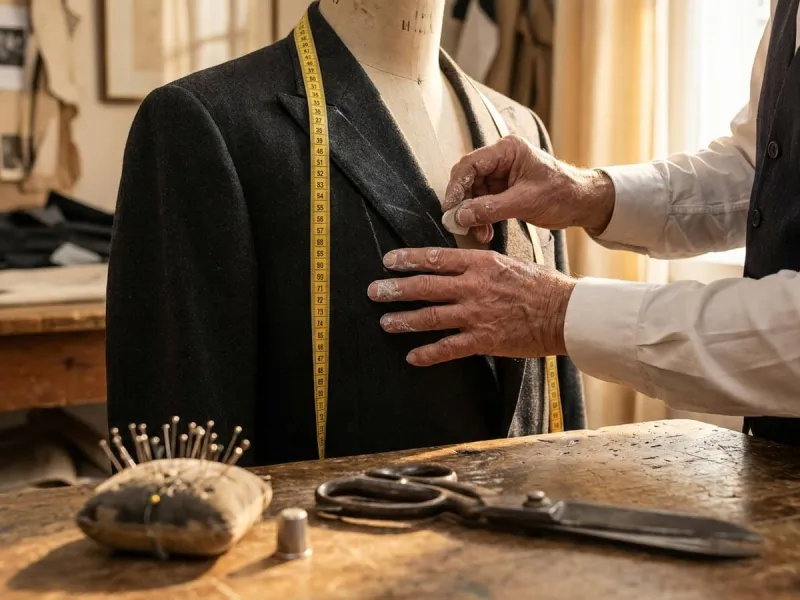
Photo: tailor workbench close-up with horn buttons thread spools and fabric swatches, via www.wallcoo.net
A finished jacket leaves the atelier looking like the work of a single, coherent intelligence. The lapel rolls, the shoulder sits, the buttonholes hold their tension. It is easy to assume that one pair of hands is responsible for all of it. In practice, a bespoke garment is the product of a small economy — a network of specialists whose names rarely appear on an invoice and almost never on a label.
The Room and the Network
Walk into any serious atelier and you will see the visible work: the cutting table, the tailors' benches, the chalk, the basting threads. What you will not see is the second workshop — the one that exists by telephone, by courier, and by decades of accumulated trust. A button maker who can match a client's horn to the shade of a cloth. A lining cutter who understands why a particular coat requires a slightly heavier silk. An embroiderer who can work a monogram at a scale that will not embarrass the wearer in daylight. A presser who knows the difference between a finish and a flattening.
What the Address Book Holds
Ask a master tailor where his buttons come from and you may receive a name rather than a brand — a family firm, perhaps two or three people, operating out of a modest building in a city you did not expect. The same is true of shoulder pads, canvas, collar melton, sleeve heads, and the small tapes and braids that hold a garment's interior architecture together. These suppliers are not interchangeable. Each has a house style, a tolerance, a way of cutting a corner or refusing to.
The address book is also an inheritance. Many tailors learn their suppliers from the person who trained them, and those relationships often predate the tailor's own career. This is one reason a young atelier can struggle to reproduce the finish of an older one even when the pattern is identical: the cloth is the same, the hands are skilled, but the network is thin.
Where It Shows in the Garment
The network is invisible until it fails or excels. When it excels, the signs are quiet: buttons that match across a full set, a lining that does not pucker at the sleeve head, buttonholes with an even tension and a clean eye, an interior that stays flat after a season of wear. When it fails, the signs are also quiet, and then suddenly loud — a replacement button in the wrong shade, a lining that bags, a shoulder that loses its line.
Clients often attribute these outcomes to the tailor alone. More accurately, they are the sum of many small decisions made by people who never met the client and never will.
The Timeline Is a Network Problem
Delay is usually described as a matter of the atelier's workload. It is just as often a matter of the network's rhythm. Small workshops close for a week; a dye lot must be matched; a specialist has a queue of his own. A house that plans its calendar around these dependencies delivers on time. A house that improvises delivers an apology.
This is one reason a wise atelier will decline a rushed commission rather than accept it and subcontract the impossible. The refusal is not a lack of confidence; it is an accurate reading of the network.
When the Book Is Too Thin
A house with few outside relationships is not automatically inferior — some ateliers do nearly everything in-house, and that can be a virtue. But clients should understand what a thin network implies: fewer redundancies, more substitution, and a greater chance that a component is chosen because it is available rather than because it is right. Substitution is not always dishonest; it is sometimes necessary. It becomes a problem when it is neither disclosed nor reflected in the price.
Five Questions Worth Asking
A discerning client need not audit the supply chain, but a few polite questions will reveal a great deal about how a house works. Who makes your buttons, and may I see the range? Are the buttonholes worked in-house or sent out? Who does the final press? What happens when a supplier retires or a mill discontinues a cloth? And, most revealing: if a component is substituted during the making, will I be told?
None of these questions require the atelier to reveal trade secrets. The manner of the answer — specific or vague, proud or defensive — tells you as much as the content.
The Client's Part
Finally, the client has a role in maintaining the network. Do not ask to contact the button maker directly; do not request that the house bypass its own finisher to save a week. These relationships are built on volume, loyalty, and discretion. A client who respects them receives better work than one who treats them as obstacles.
The little black book is not a marketing document. It is the quiet infrastructure of your garment — and, in a well-run house, one of the most reliable guarantees you will ever be offered.